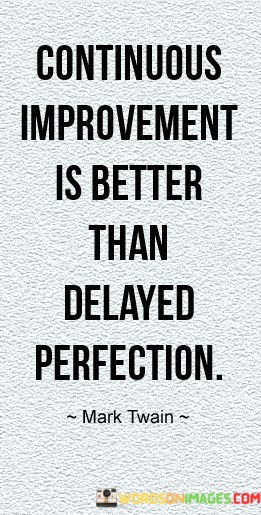
The statement "Continuous improvement is better than delayed perfection" underscores the importance of ongoing progress and growth rather than waiting for an elusive state of perfection. Key points conveyed by this statement are: Embracing Progress: Continuous improvement emphasizes the value of making consistent strides toward betterment. It encourages a proactive approach to enhancing skills, processes, and outcomes. Avoiding Procrastination: Delaying actions in pursuit of perfection can lead to missed opportunities and stagnation. By focusing on improvement rather than perfection, we can move forward and achieve tangible results. Iterative Approach: Continuous improvement is based on the idea of iterative cycles, where we learn from each step, refine our methods, and build on previous successes and failures. Learning from Mistakes: Embracing continuous improvement acknowledges that mistakes and setbacks are a natural part of growth. Instead of fearing failure, we learn from it and use it as a stepping stone for progress. Agility and Adaptability: Continuous improvement fosters agility and adaptability. It allows us to respond to changes, challenges, and feedback quickly and effectively. Incremental Progress: Small, incremental improvements over time can lead to significant advancements. Perfection, on the other hand, can be an elusive and unattainable goal that may hinder progress. In various fields, such as business, technology, sports, and personal development, the concept of continuous improvement is widely embraced. It involves seeking feedback, analyzing data, identifying areas for enhancement, and implementing changes in a continuous loop. In conclusion, "Continuous improvement is better than delayed perfection" encourages a mindset focused on progress and learning rather than a pursuit of unattainable perfection. By continuously seeking to improve and innovate, we can adapt to challenges, achieve meaningful growth, and ultimately reach higher levels of success and fulfillment. Embracing continuous improvement empowers us to take action, learn from experiences, and steadily enhance our abilities and achievements.

Continuous Improved Is Better Than Delayed Perfection Quotes

261 × 515 — JPEG 69.1 KB

Uploaded to 2 years ago — 163 views

The statement "Continuous improvement is better than delayed perfection" underscores the importance of ongoing progress and growth rather than waiting for an elusive state of perfection. Key points conveyed by this statement are: Embracing Progress: Continuous improvement emphasizes the value of making consistent strides toward betterment. It encourages a proactive approach to enhancing skills, processes, and outcomes. Avoiding Procrastination: Delaying actions in pursuit of perfection can lead to missed opportunities and stagnation. By focusing on improvement rather than perfection, we can move forward and achieve tangible results. Iterative Approach: Continuous improvement is based on the idea of iterative cycles, where we learn from each step, refine our methods, and build on previous successes and failures. Learning from Mistakes: Embracing continuous improvement acknowledges that mistakes and setbacks are a natural part of growth. Instead of fearing failure, we learn from it and use it as a stepping stone for progress. Agility and Adaptability: Continuous improvement fosters agility and adaptability. It allows us to respond to changes, challenges, and feedback quickly and effectively. Incremental Progress: Small, incremental improvements over time can lead to significant advancements. Perfection, on the other hand, can be an elusive and unattainable goal that may hinder progress. In various fields, such as business, technology, sports, and personal development, the concept of continuous improvement is widely embraced. It involves seeking feedback, analyzing data, identifying areas for enhancement, and implementing changes in a continuous loop. In conclusion, "Continuous improvement is better than delayed perfection" encourages a mindset focused on progress and learning rather than a pursuit of unattainable perfection. By continuously seeking to improve and innovate, we can adapt to challenges, achieve meaningful growth, and ultimately reach higher levels of success and fulfillment. Embracing continuous improvement empowers us to take action, learn from experiences, and steadily enhance our abilities and achievements.